
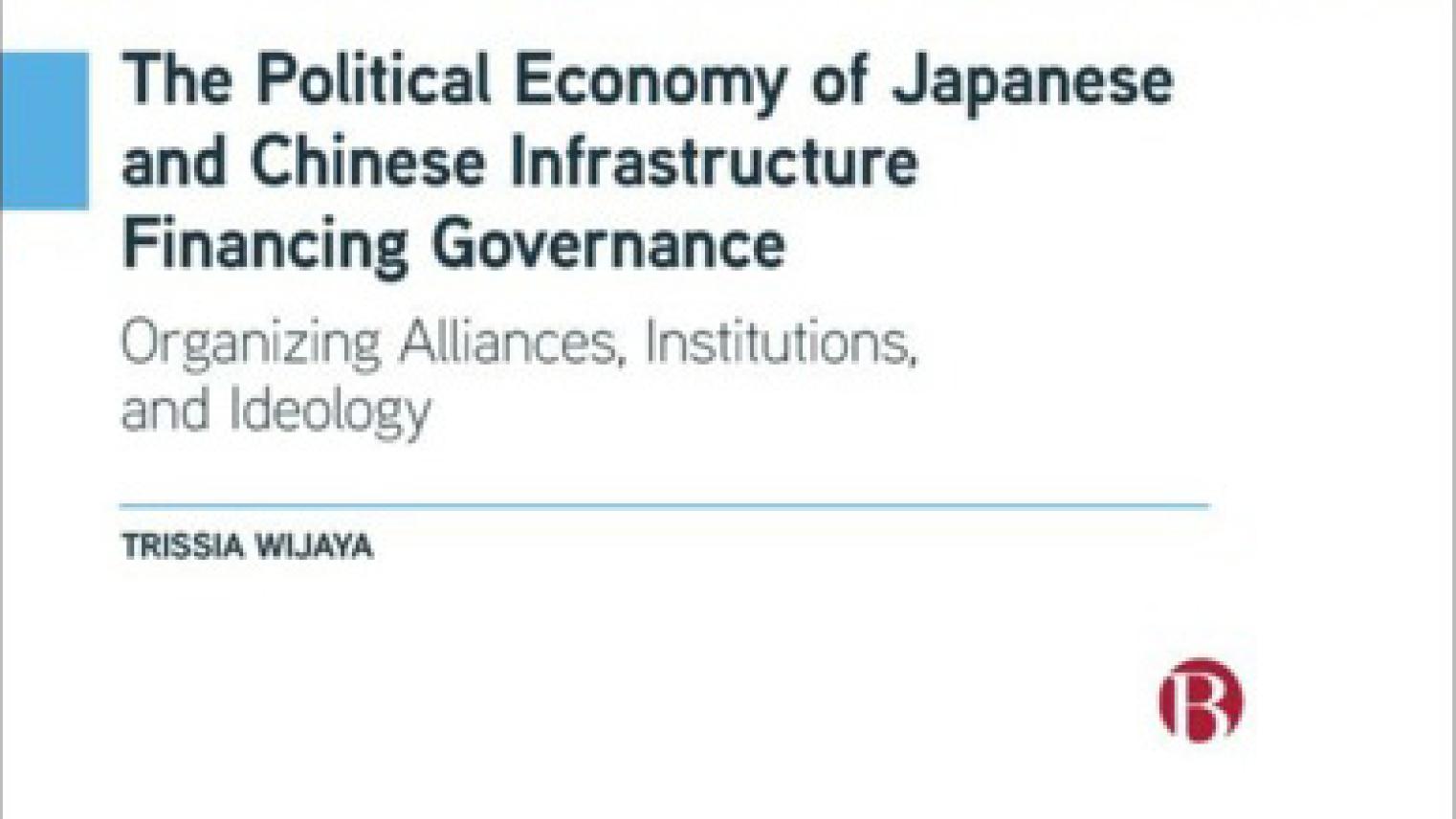
Join us for a panel discussion on Dr Trissia Wijaya’s new book.
Book Panel Discussion: The Political Economy of Japanese and Chinese Infrastructure Financing in Indonesia
Amid an increasingly militarised economy and fractured global politics, Dr Trissia Wijaya’s new book, The Political Economy of Japanese and Chinese Infrastructure Financing Governance, revisits a pivotal moment in Southeast Asia's development, when a wave of Chinese capital through the Belt and Road Initiative challenged Japan's long-standing role in the region. Focusing on Indonesia, the book asks why Chinese-led and Japanese-led infrastructure financing take such different forms.
Join us for an interactive discussion not just about this book, but about how these dynamics are being reshaped by today's geopolitics: shifting alliances, the rise of renewable energy and critical minerals in China-Southeast Asia cooperation, and how Japan is adapting as ODA loses ground to Chinese climate-tech investment.
The conversation will feature author Trissia Wijaya (University of Melbourne) in conversation with alongside Associated Professor Amy King (Coral Bell School) and Assistant Professor Yifei Li (New York University and China in the World).
Speakers
Dr. Trissia Wijaya is a McKenzie Research Fellow at the Asia Institute, University of Melbourne. Her research sits at the intersection of geopolitical economy and responses to it in East Asia, encompassing green infrastructure financing, industrial policy, and critical mineral development. Her work has been published in leading journals, including International Affairs, Environmental Politics, and the Journal of Contemporary Asia. Dr. Wijaya is an affiliate of Second Cold War Observatory network and serves as a member of the Environmental Politics and Policy Research executive committee of the Australian Political Studies Association.
Yifei Li is a Global Network Assistant Professor in the Department of Environmental Studies at New York University. He is an ethnographer, researching and writing on the theory and practice of environmental authoritarianism, with a primary empirical emphasis on China. He is the lead author (with Judith Shapiro) of China Goes Green: Coercive Environmentalism for a Troubled Planet (Polity, 2020) and co-editor (with Chris Coggins) of the Handbook on China and the Environment (Sage, 2026). His scholarly work has been featured on NPR, in The Economist, Foreign Affairs, Le Monde, and other media.
Associate Professor Amy King is Head of the Coral Bell School's Strategic & Defence Studies Centre at The Australian National University. She has published widely on China-Japan relations, the economics-security nexus in Asia, and the role of ideas in International Relations, and currently leads a team researching China's historical and contemporary role in shaping the international economic order.